Amir Washington · 20 October 2026
Exploring Stroke Dynamics for Replicating Natural Growth Patterns in Digital Botanical Illustrations
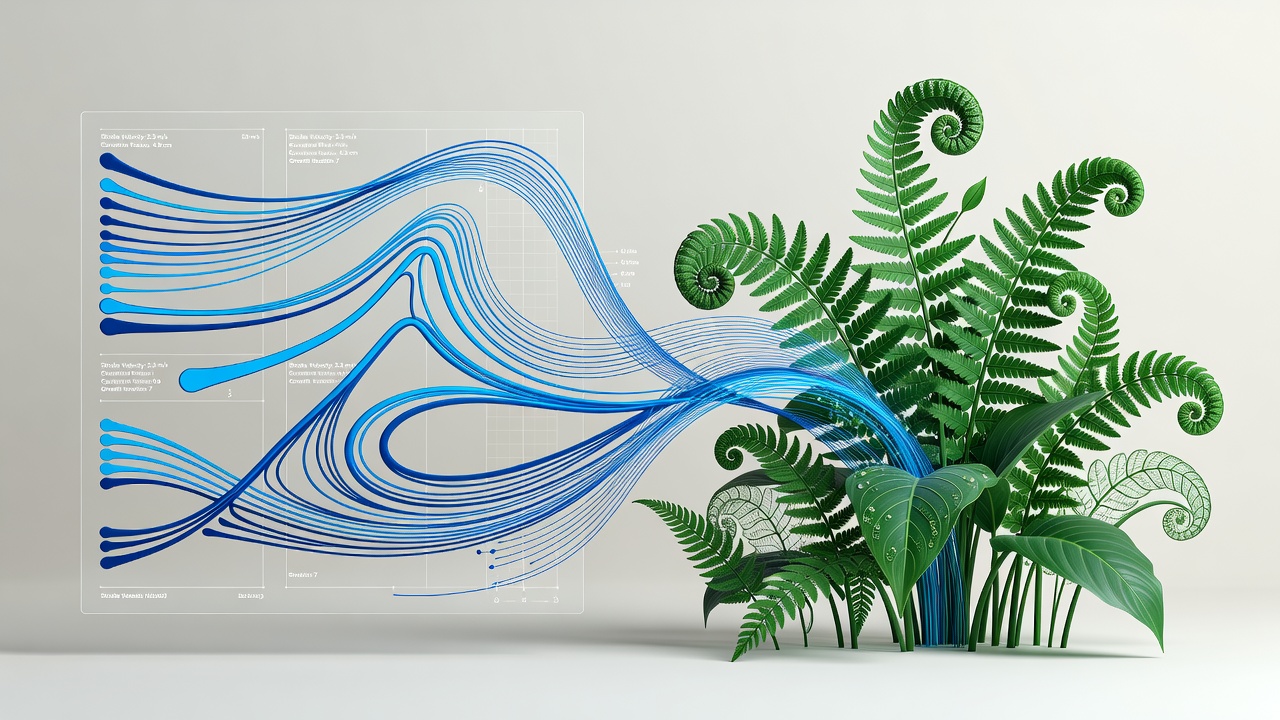
Stroke dynamics in digital tools involve the modulation of brush parameters such as pressure, velocity, tilt, and direction to control line width, opacity, and texture during the creation process, and these elements play a central role when artists seek to replicate the organic expansion seen in living plants. Natural growth patterns emerge from biological processes including cell division, phototropism, and resource distribution, which produce branching structures, vein networks, and spiral arrangements that follow mathematical sequences like the Fibonacci series. Digital botanical illustration requires mapping these biological rules onto software controls so that each stroke can simulate incremental extension rather than static outlines.
Core Parameters in Stroke Modulation
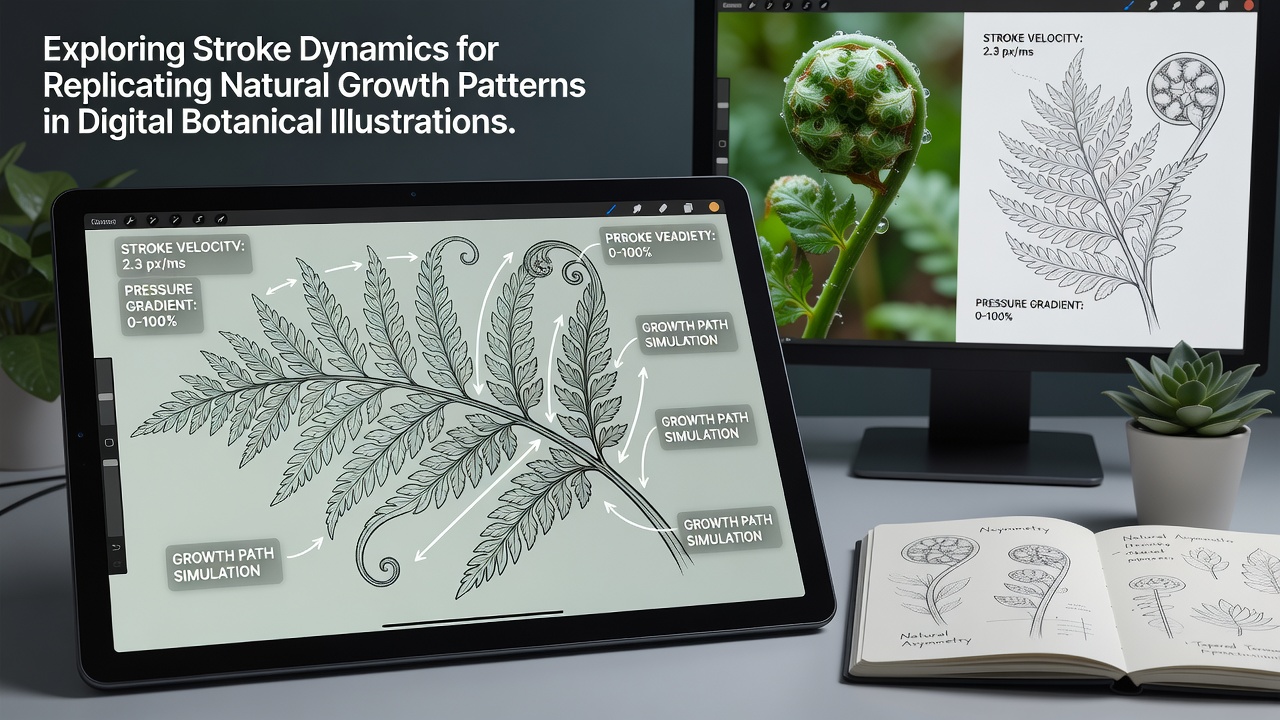
Pressure sensitivity adjusts the thickness and density of marks in real time, allowing a single stroke to thicken at the base where support tissue would accumulate and taper toward the tip where newer growth occurs, while velocity influences the spacing of texture elements so slower movements deposit denser detail that corresponds to areas of slower biological expansion. Tilt and rotation data from input devices further refine edge quality, creating the subtle asymmetry found in leaves that develop under uneven light exposure. Software engines record these inputs as variable data streams that can be replayed or edited, giving illustrators the ability to refine a growth sequence after the initial mark has been placed.
Mapping Biological Rules to Digital Strokes
Researchers have documented how phyllotactic spirals and bifurcation patterns can be approximated through algorithmic brush behaviors that respond to underlying vector fields, and several studies demonstrate that artists achieve more convincing results when stroke direction follows simulated auxin flow rather than arbitrary curves. Data from procedural modeling experiments indicate that combining multiple stroke layers, each governed by distinct dynamic profiles, produces depth that single-pass techniques cannot match. For instance, an initial set of broad strokes might establish primary stems using high-pressure, low-velocity settings, after which finer strokes with reduced pressure and increased speed add lateral branches that respect the original divergence angles.
Texture synthesis within the brush engine also contributes to realism because natural plant surfaces exhibit micro-variations in cell structure that change along the growth axis. Observers note that when stroke dynamics include randomized yet constrained jitter in opacity and grain, the resulting marks more closely resemble the transition from mature tissue to meristematic regions. Calibration curves supplied by hardware manufacturers allow users to match input response to the specific growth model they intend to represent, whether that model emphasizes rapid elongation in vines or compact rosette formation in succulents.
Current Implementations and Workflow Integration
Contemporary illustration applications expose stroke dynamics through layered brush presets that can be linked to custom curves derived from botanical measurements, and these presets often incorporate reference data from sources such as the CSIRO plant architecture database. Artists typically begin with a skeletal vector framework that encodes expected growth directions, then overlay dynamic raster strokes whose parameters are driven by the underlying vectors. This hybrid approach permits both precise structural control and organic surface variation within a single file. In October 2026 several digital art conferences are scheduled to present updated toolkits that further couple stroke engines with real-time simulation of environmental factors such as light direction and nutrient gradients.
Case examples from institutional studios show that teams achieve consistent results across multiple illustrators when they standardize dynamic profiles rather than relying on individual brush feel alone. One documented workflow at a European research visualization lab used pressure-velocity mappings calibrated against time-lapse photography of actual seedlings, resulting in illustrations whose growth sequences could be validated against the source imagery frame by frame. Such calibration reduces the trial-and-error phase that previously consumed significant production time.
Conclusion
Stroke dynamics provide a controllable interface between biological observation and digital mark-making, enabling illustrators to build botanical imagery that respects measured growth parameters while retaining the flexibility of hand-driven input. Continued refinement of input mapping, combined with data from ongoing botanical studies, supports increasingly accurate replication of natural patterns across diverse plant species and growth stages.